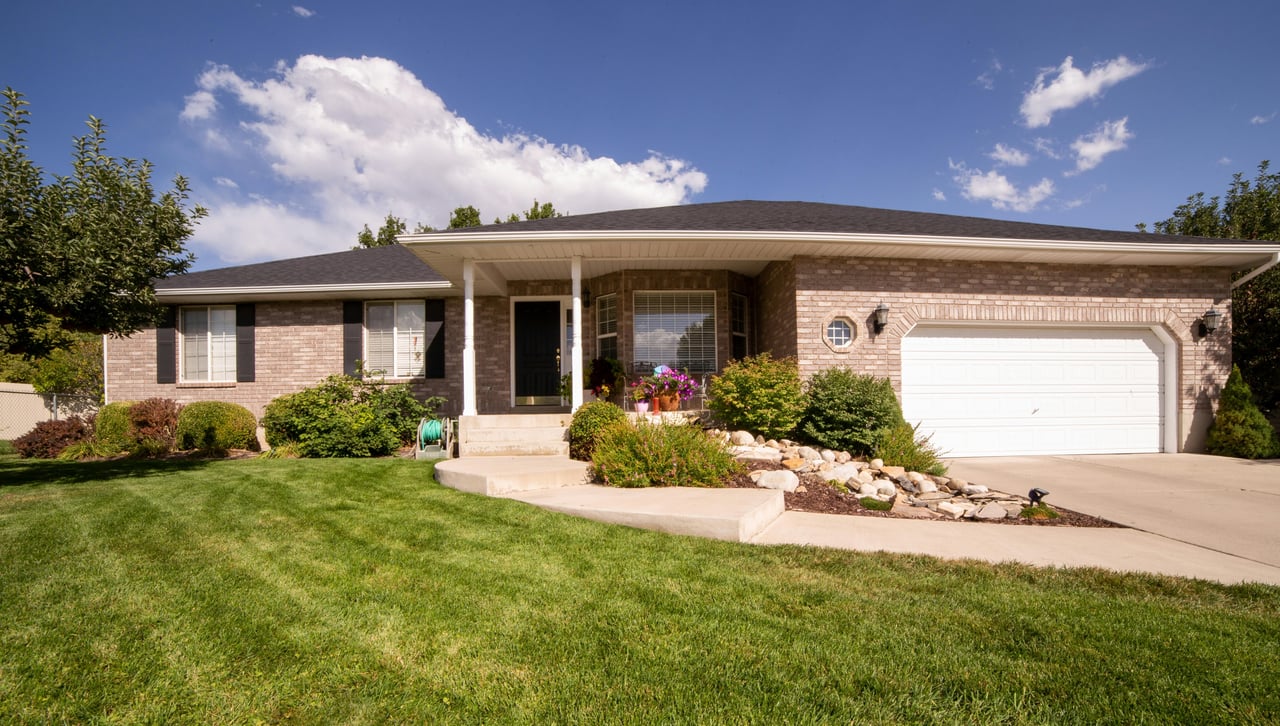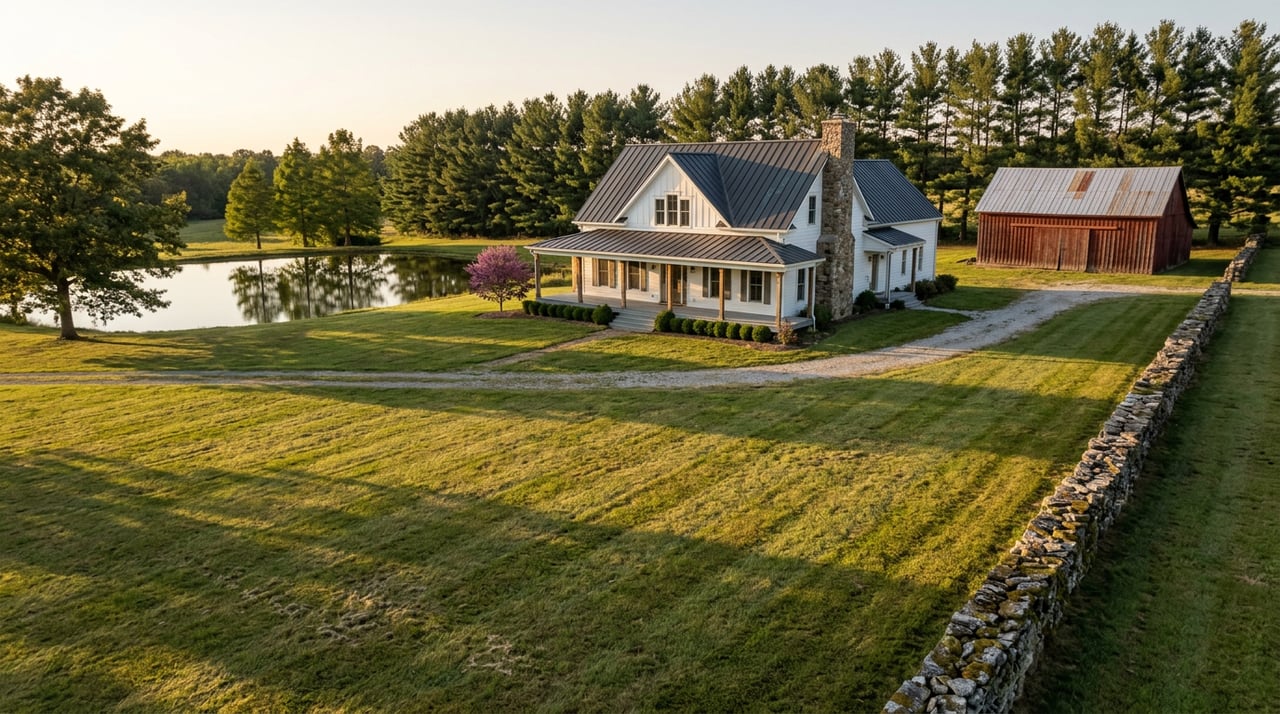
A hunter looking for acreage in Parke County pulls up a land-listing aggregator this summer and sees a number that stops him: the average acre in the county is going for around $41,000. He closes the tab, assuming the county has priced him out. Then he finds a 71-acre property outside Bloomingdale, listed this year at $859,000, which works out to roughly $12,100 an acre. Same county. Same season. A gap wide enough to make either number look wrong.
Neither one is. They are measuring two different products that happen to share a zip code, and the average blending them together is close to useless for anyone trying to price an actual offer.
One County, Two Products
Parke County land falls into two markets that behave nothing alike. The first is working farmland: row crop and hay ground bought and sold on the strength of its cash-rent income and productivity index, the same way you'd price an apartment building on its rent roll. The second is recreational and lake-adjacent land, priced almost entirely on scarcity and proximity to Raccoon Lake, Turkey Run State Park, and the Covered Bridge Festival grounds. Soil quality barely enters that conversation.
Once you separate the two, the wide spread in advertised prices stops looking like noise and starts looking like a map. A parcel's price tells you which market it belongs to before you ever read the listing description.
What the Numbers Actually Show
Pull active listings for either county this year and you'll see a similar spread depending on which slice of the market you're sampling.
| Source and county | Sample | Average price per acre |
|---|---|---|
| Putnam County farm sales, 2024 | County-wide farmland sales report | $10,558/acre |
| Putnam County listings, land-only | 3 active listings | $10,559/acre |
| Putnam County listings, mixed use | 31 active properties | $19,017/acre |
| Parke County listings, mixed use | 20 active properties, 275 total acres | $41,145/acre |
The Putnam County farmland figure of $10,558 an acre comes from a 2024 sales report and reflects a price per productivity index point of $124.27, with the highest recorded sales reaching $13,252 an acre for the best ground. That number moves in a narrow band because it's tied to what the land can grow and rent for.
The Parke County figure is a different animal. It's built from a small sample of 20 active listings covering only 275 acres, and it's pulled upward by parcels that have almost nothing to do with farming: a corner lot near the Mansfield Covered Bridge access point marketed for its festival foot traffic, lake-view lots in named subdivisions, and small acreages advertised for their frontage on Sugar Creek rather than their tillable ground. Mix a handful of premium recreational parcels into a small sample and the average stops describing farmland at all.
Why Raccoon Lake and Turkey Run Move the Price, Not the Soil
Two features do most of the work in Parke County's recreational premium, and neither shows up on a soil survey.
Raccoon Lake, officially Cecil M. Harden Lake, is a 2,060-acre flood-control reservoir the Army Corps of Engineers built by damming Big Raccoon Creek between 1956 and 1960. It draws boaters and bass anglers to named lakefront subdivisions like Hidden Lake and Paradise Bay, and the lake has produced the second-largest striped bass ever caught in the state. None of that has anything to do with what the ground underneath is worth as cropland. It has everything to do with what a buyer will pay for a dock and a view.
"It's seh-sill, not see-sill."
That's how one Indiana state parks writer clarified the pronunciation of Cecil Harden's name, a five-term U.S. Representative who advocated for the lake's creation as a recreation area. It's a small detail, but it captures how much of the lake's identity, and its land premium, rides on local familiarity rather than anything a spreadsheet can price.
Turkey Run State Park does something similar a few miles away. The park covers 2,382 acres including the 1,609-acre Rocky Hollow-Falls Canyon Nature Preserve along Sugar Creek, and it draws somewhere between 700,000 and well over a million visitors a year depending on which count you trust. Right now, in the second half of 2026, both U.S. 41 and State Road 47 have sections closed near the park through early September due to Sugar Creek, a reminder that access to this land is genuinely tied to a live waterway, not a fixed asset. Parcels near the park's edge or along the Covered Bridge Festival route get advertised for visibility and traffic, not yield.
How Cash Rent Explains the Farmland Number
The farmland side of the county prices far more predictably, and Purdue's Center for Commercial Agriculture laid out why in its 2026 Farmland and Cash Rent Outlook. Cash rent for top-quality Indiana farmland rose 1.7% in 2026, from $313 to $318 an acre. Average-quality ground rose 1.6% to $264 an acre, and poor-quality ground rose 1.53% to $207 an acre. Those are small, steady moves, the kind you'd expect from an asset priced on income rather than emotion.
The Chicago Fed's data backs this up: Indiana farmland values rose 6% year over year in 2025 but sat mostly flat quarter to quarter, which Purdue's researchers read as the market entering a stabilization period after several years of faster gains. Listings that report FSA tillable acreage and a productivity score, the kind you'll see on working farms outside Bainbridge or Russellville, are pricing off that same steady logic.
Recreational land isn't playing by those rules at all. Purdue's report found that recreational land values jumped 18% from 2024 to 2025 statewide, even as traditional cropland values were held down by weak net farm income and softer commodity prices. That's the gap showing up in the Parke County listings: one submarket moving at low single digits, the other moving at nearly twenty percent in a single year.
What This Means If You're Evaluating a Parcel Right Now
The county average won't tell you what to offer. What will:
- For working farmland: ask for the FSA tillable acreage, the productivity index score, and whether the ground is currently cash rented. A parcel priced near $10,000 to $13,000 an acre in Putnam County is behaving like farmland should. A number well above that deserves a second look at what else is being counted.
- For lake-adjacent land: check which subdivision it sits in, since Hidden Lake and Paradise Bay carry their own covenants and lot restrictions, and confirm actual water access rather than assuming lake view means lake access.
- For festival or park-adjacent land: treat the foot-traffic premium as separate from the land's underlying agricultural or residential value, and ask what the parcel is worth the other fifty weeks of the year when the Covered Bridge Festival isn't in town.
- For anything advertised with a countywide average in the listing copy: ask what that average is actually built from. A sample of 20 listings covering 275 acres is not a stable benchmark for pricing a specific 40-acre offer.
The Gap Is Widening, Not Closing
The most useful thing in Purdue's 2026 outlook isn't the farmland number. It's the direction. Recreational land values climbing 18% in a year while cropland moves in low single digits means the split we're seeing in Parke County listings right now isn't a temporary quirk of a small sample. It's the shape the market is taking. Development pressure from solar projects and data-center activity is adding a third pull on land values in some parts of the state, which only makes a single countywide average less useful going forward, not more.
If you're comparing acreage between Putnam and Parke counties, the question isn't which county has the better price per acre. It's which product you're actually buying, and whether the listing price reflects that product's real economics or borrows from the wrong one.
A Few Straight Answers
Does lake frontage on Raccoon Lake always cost more than farmland nearby? Not automatically, but it's priced on a different basis. Lake lots in subdivisions like Hidden Lake and Paradise Bay are valued for water access and views, while farmland a mile away is valued for tillable acreage and cash rent. Comparing the two per-acre figures directly tells you less than comparing each to others in its own category.
Why would a small parcel near Mansfield cost more per acre than a large working farm? Proximity to the Covered Bridge Festival route and the Mansfield access point adds a visibility premium that has nothing to do with soil. A 2-acre corner lot marketed for festival foot traffic is being priced like a small commercial site, not like farmland.
Is the countywide average price per acre worth using at all? It's a starting point for understanding the range, not a number to base an offer on. Given how few properties make up some of these samples, the average can shift heavily based on whether a single high-value lake lot or festival-adjacent parcel happens to be listed that month.
If you're weighing a parcel in Putnam or Parke County and want help figuring out which market it actually belongs to, Dyer Creek Property Group has spent years working both sides of this line, from row-crop farms to lakefront lots. Reach out and we'll walk through the numbers with you before you write an offer.